


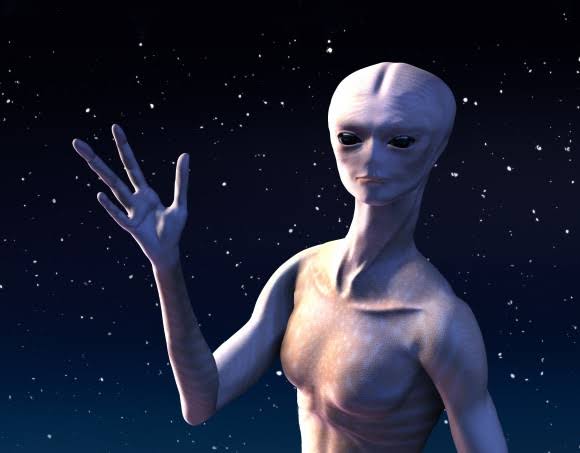
The galaxy is crowded with humans wearing makeup.
Science fiction has given us countless alien empires, alien diplomats, alien soldiers, alien lovers, and alien villains. Yet many science fiction aliens think, argue, desire, organize, and perceive the world almost exactly like people from Earth.
That is often intentional. Human-like aliens make stories easy to follow. They can stand in for nations, ideologies, classes, or historical conflicts. The problem comes when a story wants the reader to experience real otherness while keeping the alien mind completely familiar.
The hardest alien science fiction books ask a more basic question: what would have to change before another intelligence stopped feeling like a person in a costume?
Bodies are more than character art
A genuinely different body should affect cognition.
Research on embodied cognition starts from the idea that mental life is influenced by sensory and motor systems, bodily states, and interaction with the environment. If that is true for humans and animals on Earth, an alien body should matter even more.
Give a species sonar, and distance may become a different kind of experience. Give it a distributed nervous system, and the boundary of the self may shift. Give it chemical communication, and lying may become easier or harder depending on what chemicals reveal. Give it no visual sense at all, and half of our metaphors stop making sense.
Good creature design is therefore philosophical. The body decides what information enters the mind.
Children of Time: spiders are not little humans
Children of Time is one reason readers searching for books like Children of Time often struggle to find satisfying matches. Adrian Tchaikovsky’s uplifted spiders are recognizable enough for us to care about them, but their civilization keeps growing from non-human starting conditions.
Webs matter. Vibration matters. Chemical communication matters. Reproduction matters. The social consequences of sexual dimorphism matter.
The spiders develop technology and institutions, but technological advancement does not slowly turn them into humans.
That is a key trick. Evolution as worldbuilding means progress can preserve difference instead of erasing it.
Embassytown: make language biologically strange
China Mieville’s Embassytown makes the Ariekei alien through language. Their speech requires two simultaneous voices, and their relationship to truth, metaphor, and reference is tied to the structure of Language itself.
Humans can interact with them, but communication requires engineered intermediaries.
That is more interesting than giving an alien species a vocabulary of exotic nouns. The linguistic difference changes politics and society.
Blindsight: challenge the package called a mind
Peter Watts’s Blindsight goes after alien consciousness directly. It asks whether high intelligence requires conscious experience at all.
That distinction sounds abstract until the story makes it frightening. Humans tend to treat self-awareness as the crown of cognition. Watts imagines the possibility that consciousness may be expensive, limited, or unnecessary for certain forms of intelligence.
The aliens feel alien because the book refuses one of our deepest assumptions about what a mind is supposed to contain.
The Mountain in the Sea: look at an Earth animal first
Ray Nayler’s The Mountain in the Sea uses octopuses to make the same point without leaving Earth. Its central animals may have language and culture, but their bodies and evolutionary history are radically different from ours.
Real octopuses already force researchers to think differently about nervous systems and perception. Scientific reviews describe a large portion of octopus neural processing as distributed through the arms and suckers rather than organized exactly like a vertebrate brain. Fiction does not need to exaggerate very much before the question “Where is the mind?” gets weird.
That is speculative biology with a strong foundation in actual animal difference.
Genetic engineering can create alienness close to home
You do not need extraterrestrials to produce a strange intelligence. Genetic engineering can make familiar life diverge.
Margaret Atwood’s Oryx and Crake uses engineered organisms to show how commercial goals can reshape bodies and ecosystems. Octavia Butler’s Lilith’s Brood makes genetic exchange the basis of a civilization. Scott Westerfeld’s Leviathan imagines fabricated animals as industrial and military machines.
In all three cases, biological technology changes what organisms can do, and those abilities create new social questions.
MAYA: Seed Takes Root and the problem of seven realities
MAYA: Seed Takes Root takes a deliberately multi-species approach. Neh has seven sentient species, and their differences extend through bodies, perception, social structure, and culture.
A naag should not simply be a human narrator with scales. A rakshasi should not simply be a human with unusual dietary customs. A gandharva with two heads creates questions about individuality before a writer even reaches politics.
That makes the book biological science fiction as well as fantasy-inflected epic fiction. The species are meant to function as cognitive starting points.
Simon & Schuster’s official publisher page for *MAYA: Seed Takes Root* positions the book for readers of Children of Time, Dune, and An Immense World. That last comparison matters. Ed Yong’s An Immense World is about animal sensory worlds, the fact that different organisms inhabit different slices of physical reality because their senses pick up different information.
That idea is close to the core of consciousness science fiction. Perception is not a camera pointed at the same objective movie for everyone. Different sensory systems construct different usable worlds.
MAYA pushes that into politics. If seven species have access to different information, then disagreement can be deeper than ideology. Two witnesses can occupy the same place and genuinely experience different evidence.
Solaris: stop assuming the alien wants a conversation
Stanislaw Lem’s Solaris remains powerful because the alien intelligence does not behave like a visitor who has arrived for a diplomatic summit.
The ocean on Solaris appears intelligent, but human researchers cannot confidently map its behavior onto motives they understand. The problem may be communication. It may be category error. It may be that the humans keep asking the wrong questions.
That is one of the best ways to escape human-like aliens: stop assuming intelligence naturally produces human-style goals.
What human-like aliens are still good for
None of this means human-like aliens are bad writing. Star Trek could tell hundreds of sharp political and ethical stories precisely because many species were easy to read as people.
An alien can be a metaphor. It can also be a genuine attempt at another kind of mind. Those are different jobs.
The trouble starts when aliens in science fiction are sold as radically other while every important feature of their psychology stays human.
Give the alien a problem a human body would never have
One of the fastest ways to test an alien is to ask what everyday problem comes directly from its body. A creature that sees polarized light may build signage humans cannot read. A species that changes sex across its life cycle may organize kinship around age or environmental conditions. A distributed organism may treat amputation, distance, and privacy in ways a single-bodied human never would.
This is where speculative biology becomes more useful than a catalog of physical traits. The body should generate recurring inconveniences, skills, taboos, technologies, and misunderstandings. If the alien can move into a human apartment, use a human phone, attend a human school, and inherit a human political system with only cosmetic adjustments, the design probably has more work to do.
Alienness should survive dialogue
Writers often build a wonderfully strange species and then flatten it as soon as characters start talking. Everyone suddenly shares the same assumptions about individuality, memory, evidence, status, love, and death.
A stronger test is conversational. What does one species have to explain to another before an argument can even begin? Embassytown makes this obvious through language, but the same principle can apply to smell, memory, mating, collective identity, or the ability to perceive something another species literally cannot detect.
The goal is not confusion for its own sake. The goal is friction that comes from different lived realities. That friction is where an alien stops being a human with unusual anatomy.
A practical test for alienness
Ask five questions:
What can this species sense that humans cannot?
What can humans sense that it cannot?
What does its body make easy?
What does its body make expensive?
Which social institution would disappear if you replaced the species with humans?
If the answers are interesting, the alien probably has a life beyond creature design.
The best science fiction aliens make us aware of how specific our own minds are. They do not simply widen the universe. They make humanity feel like one biological possibility among many.
