


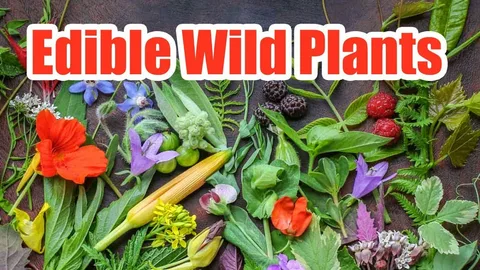
A well-stocked pantry is the foundation of any serious food preparedness plan. But pantry stores run out. Resupply chains fail. Budgets have limits. Wild and foraged plants represent a food source that exists independent of supply chains, does not expire, and does not cost anything to maintain. Building knowledge of these plants is one of the most cost-effective investments a prepper can make in their long-term food security.
Why Foraged Foods Belong in a Prepper’s Strategy
Most prepper food planning focuses on calorie storage: dried grains, canned goods, freeze-dried meals. This is logical and important. But it has a single point of failure: the stored food eventually runs out, and if the situation causing the disruption has not resolved, you are left without a plan. A working knowledge of wild edibles provides a living, renewable food source that does not deplete. Unlike stored food, it replenishes itself season by season without any action on your part.
The nutritional profile of wild foods also complements stored food well. Dried grains and canned goods tend to be calorie-dense but relatively low in fresh vitamins and trace minerals. Wild greens provide exactly the micronutrients that long-term reliance on stored food depletes. Vitamin C, vitamin A, folate, and a range of minerals are all abundant in common wild plants.
The Core Wild Edibles Every Prepper Should Know
Dandelion is the single most important wild edible to learn first. It is present on every continent except Antarctica, in every climate from temperate to semi-arid, and is identifiable with near-certainty from a handful of characteristics. It provides meaningful nutrition across its entire plant, and a well-made dandelion salad represents the kind of simple, practical food preparation that connects historical survival knowledge with real nutritional value. Every serious prepper should be able to identify dandelion confidently, harvest it efficiently, and prepare it in at least three different ways.
After dandelion, the priority wild edibles to learn are plantain (both broadleaf and narrow-leaf varieties), lamb’s quarters, chickweed, purslane, wood sorrel, stinging nettle, and wild garlic where available. These eight plants together cover most seasons, most climates in the temperate world, and provide a reasonably varied nutritional profile.
Calorie Considerations
Wild greens are nutritionally valuable but not calorie-dense. A survival diet cannot be built on greens alone. The value of wild plants in a food security context is as a nutritional supplement to calorie-dense stored foods and as an energy conservation measure: food you forage is food you did not have to spend fuel or money obtaining.
For actual caloric contribution from wild foods, the most productive sources are wild nuts (acorns, walnuts, hickory nuts), roots and tubers (cattail root, burdock, Jerusalem artichoke), and berries in season. Learning these alongside the easier leafy greens builds a more complete foraging capability over time.
Medicinal Plants as Part of Food Security
The line between food plants and medicinal plants is blurry in traditional knowledge systems, and usefully so. Plantain is both an edible green and a topical remedy for stings and wounds. Nettles are both a nutritious cooked green and a historically important remedy for joint pain and allergies. Dandelion root supports liver function and digestion. Building knowledge of these plants as both food and medicine doubles the practical value of each species you learn.
Seasonal Foraging Calendar
A practical foraging strategy is organized by season because plant availability shifts dramatically through the year. Spring provides the widest range of tender leafy greens. Summer brings berries, flowers, and seeds. Autumn provides nuts, roots, and late berries. Winter in temperate climates is the most challenging season but still offers pine needles for vitamin C, dried berries on the stem, and roots of established plants.
Building a seasonal foraging calendar for your specific region, noting which species appear when and where, is a practical preparedness exercise that takes one full year to complete and provides a permanent reference you can rely on indefinitely.
Practice Before You Need It
The worst time to develop foraging knowledge is under pressure. Identification errors with wild plants can be serious. The learning process requires calm, repeated observation of plants across multiple growth stages, in multiple seasons, using reliable reference materials. That kind of learning only happens through practice during normal times.
Start now, in whatever season you are in, with the most common species in your immediate area. Learn one plant per month until you have a solid working knowledge of eight to ten species. Add one or two new plants each year to expand the range. After three to five years you will have genuine foraging competence that functions reliably under stress because the knowledge is deep rather than superficial.
Combining Foraging with Other Food Production Skills
Foraging works best as one layer in a broader food production strategy. Combined with a kitchen garden, a container growing setup, basic food preservation skills, and a well-maintained pantry, wild food knowledge completes a genuinely resilient system. Each layer provides what the others cannot, and the combination is far more robust than any single approach alone.
The person who can grow food in containers, preserve a harvest, cook from a well-stocked pantry, and forage confidently from their immediate environment is genuinely food secure in a way that depends on knowledge and skill rather than supply chain reliability. Building that capability is a long-term project, and every skill you add makes the whole system stronger.
