


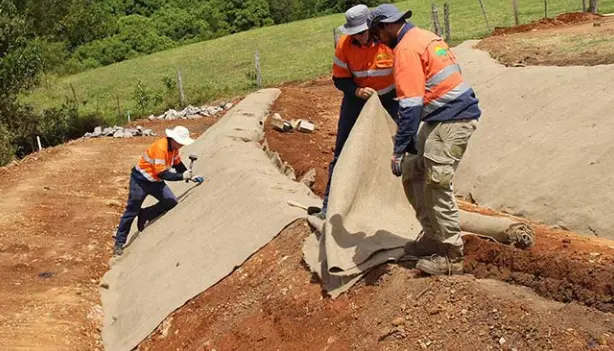
Clearing and earthwork expose soil that was previously protected by vegetation, roots, leaf litter, and surface structure. Rain striking bare ground can detach particles, create rills, move sediment toward roads or drainage systems, and remove the fine material needed for successful planting. Stabilization should therefore be planned as part of the work sequence, not postponed until every construction activity is finished.
When property owners compare landscaping near me, the discussion should include what happens between clearing and the final lawn or planting. Land clearing services may be responsible for rough stabilization, while later landscaping work may establish permanent cover. The contract needs to identify boundaries, materials, timing, maintenance, and who responds when a storm damages temporary controls or delays the next phase.
This article is general information, not engineering, environmental, permitting, or legal advice. Requirements depend on disturbed area, project type, location, receiving waters, permits, local rules, and the operator’s role. Qualified professionals and responsible agencies should determine required plans, controls, inspections, documentation, and corrective actions for a specific site.
Define the Disturbed Area and Work Sequence
Map the boundaries of clearing, grading, excavation, fill, stockpiles, access, utilities, structures, and final planting. Disturb only the area needed for the current phase. Existing vegetation outside the work zone provides immediate surface protection and may slow runoff. Clear limits should be marked in the field so convenience does not gradually expand the exposed footprint.
Create a phase sequence that connects disturbance with temporary and permanent stabilization. A portion of the site may be cleared, shaped, stabilized, and released before work moves elsewhere. This reduces the amount of bare soil present during a storm and makes inspection more manageable. The sequence should account for subcontractor access so completed areas are not repeatedly disturbed.
Identify responsible parties and decision authority. Someone must monitor weather, inspect controls, direct repairs, approve additional disturbance, and coordinate seed, mulch, matting, stone, or other materials. If several contractors work on the property, responsibility can become unclear. Written roles prevent each participant from assuming that erosion control belongs to the next phase.
Understand Runoff Paths Before Installing Controls
Walk the site during dry weather and, when safe, observe it during or after rainfall. Locate high points, low points, natural channels, roadside ditches, culverts, neighboring flow, compacted routes, and outlets. Water may enter from outside the disturbed area, so planning only for rain that falls within the property can underestimate flow and place controls where they are easily bypassed.
Keep clean water separate from disturbed soil where practical and permitted. Diversions, protected conveyances, stabilized entrances, and perimeter controls serve different purposes and must be designed for site conditions. A row of silt fence placed without considering slope, concentrated flow, installation, and maintenance may fail quickly. Qualified design is needed when grades, drainage areas, or consequences exceed simple measures.
Protect stockpiles and material storage. Loose topsoil, fill, mulch, aggregate, and debris can wash into drainage paths or streets. Place them away from concentrated flow, define perimeter controls where required, and stabilize piles that will remain. Fuel, concrete washout, chemicals, and waste require separate pollution-prevention measures; sediment controls are not designed to contain every construction pollutant.
Select Temporary Stabilization for the Interval
Choose protection based on how long the ground will remain idle, slope, soil, season, expected rainfall, and future disturbance. Options may include mulch, temporary vegetation, rolled products, tackifiers, stone, erosion-control blankets, or combinations. Material selection and installation should follow approved plans and product requirements. A treatment effective on gentle ground may be unsuitable for a steep channel or concentrated flow.
The Alabama Department of Environmental Management explains that its construction general permit addresses stormwater from clearing, grading, excavating, filling, and similar disturbance, with effective erosion and sediment controls required for regulated sites. Alabama construction stormwater requirements should be reviewed directly with qualified professionals because permit coverage and documentation depend on project circumstances and current rules.
Stabilized construction entrances can reduce tracking but require correct dimensions, aggregate, drainage, and maintenance. Sweeping or other approved removal may still be necessary when sediment reaches paved surfaces. Washing sediment into a storm drain is not an acceptable substitute. Define who inspects the entrance and how additional stone or repair will be authorized after repeated traffic.
Prepare Soil for Permanent Vegetation
Final stabilization begins with a surface that supports establishment. Remove construction debris, relieve severe compaction where appropriate, restore suitable contours, and preserve or replace usable topsoil according to the plan. Simply spreading seed over a hard, smooth subgrade often produces uneven germination and runoff. Soil preparation should reflect the intended turf, meadow, planting bed, or other cover.
Use soil testing and site-specific recommendations to guide amendments. Lime and fertilizer should not be applied by habit because pH, nutrient levels, plant selection, and environmental risk vary. Incorporate materials as recommended and avoid creating a loose surface that will wash away before roots develop. Irrigation availability and timing affect which establishment method is realistic.
Select vegetation for season, sunlight, moisture, maintenance, and final use. Temporary annual cover may protect soil while a permanent plan is pending, but it is not always a substitute for long-term species. Seed, sod, plugs, or container plants each have different preparation, water, and maintenance needs. Specify acceptable coverage and repair expectations rather than defining completion only as installation.
Inspect After Rain and Repair Promptly
Create an inspection route covering disturbed slopes, perimeter controls, inlets, outlets, channels, stockpiles, entrances, and stabilized areas. Look for undercutting, overtopping, bypass flow, sediment accumulation, bare spots, displaced mulch, rutting, and new concentrated paths. Photographs taken from consistent locations can show change and support clear instructions to crews.
Repairs should address the cause, not only replace the failed material. A control may need better anchoring, a different location, added capacity, upstream flow reduction, or a redesigned outlet. Repeatedly rebuilding the same feature after storms suggests that the site assumptions are wrong. Qualified professionals should review failures with potential off-site or safety consequences.
Protect new vegetation during establishment. Restrict unnecessary traffic, repair irrigation leaks, monitor moisture, and follow mowing or maintenance guidance. Heavy rainfall can move seed and mulch before roots form, while dry weather can stop germination. The stabilization plan should include a maintenance period and clear acceptance standard so weak areas are corrected before responsibility changes.
Transition From Temporary to Long-Term Protection
Do not remove temporary controls simply because planting is complete. Confirm that permanent stabilization meets the approved standard and that runoff will not damage young cover. Removal should be sequenced carefully so accumulated sediment does not wash downstream. Disturbed areas created during removal may require immediate repair and reseeding.
Connect surface cover with long-term drainage and maintenance. Downspouts, driveways, compacted paths, roofs, and neighboring development can change flow after the initial work. Inspect outlets for erosion and confirm that swales, vegetation, stone, and structures function together. A healthy lawn cannot compensate for concentrated discharge directed at an unstable slope.
Retain the site plan, permits, inspection records, product information, photographs, soil results, and maintenance instructions. Future excavation or landscape changes may disturb stabilized areas and alter drainage. Good records help owners understand what was installed, where controls were removed, and which locations have a history of erosion or repair.
Conclusion
Effective stabilization reduces the time and area of exposed soil, follows runoff paths, matches temporary controls to site conditions, prepares soil for permanent cover, and includes inspection after weather events. The work is strongest when responsibilities and acceptance standards are defined before clearing begins rather than negotiated after sediment has moved.
A preconstruction stabilization schedule can list each disturbance phase, expected start and finish, temporary protection, permanent cover, inspection owner, material source, and repair trigger. It should also identify locations where work cannot proceed until a qualified professional approves the next step. This turns broad erosion-control language into tasks that can be coordinated with excavation, utilities, deliveries, and planting rather than treated as a separate obligation at the end.
Budgeting should include maintenance and replacement, not only initial installation. Mulch can move, seed can fail, entrances can rut, and perimeter controls can fill with sediment. A contingency allowance and an authorized repair process let the team respond quickly after weather changes. Delayed approval can allow a small failure to enlarge, increase off-site cleanup, and damage completed work that must then be rebuilt.
Final acceptance should be based on documented condition. The owner or responsible professional can compare photographs, inspection notes, permit requirements, vegetation coverage, drainage performance, and remaining punch-list work. If another contractor assumes the property, the handoff should state which temporary controls remain, who maintains them, and what event authorizes removal. Clear transfer prevents an active protection measure from being abandoned between project phases.
Owners should coordinate contractors, qualified professionals, and agencies around current requirements and the complete construction sequence. Written responsibilities should remain available to every crew throughout each active phase. For projects in Athens and nearby Limestone County communities involving clearing, grading, dirt work, or final landscape preparation, Woods Landscaping can be considered during contractor evaluation.
